
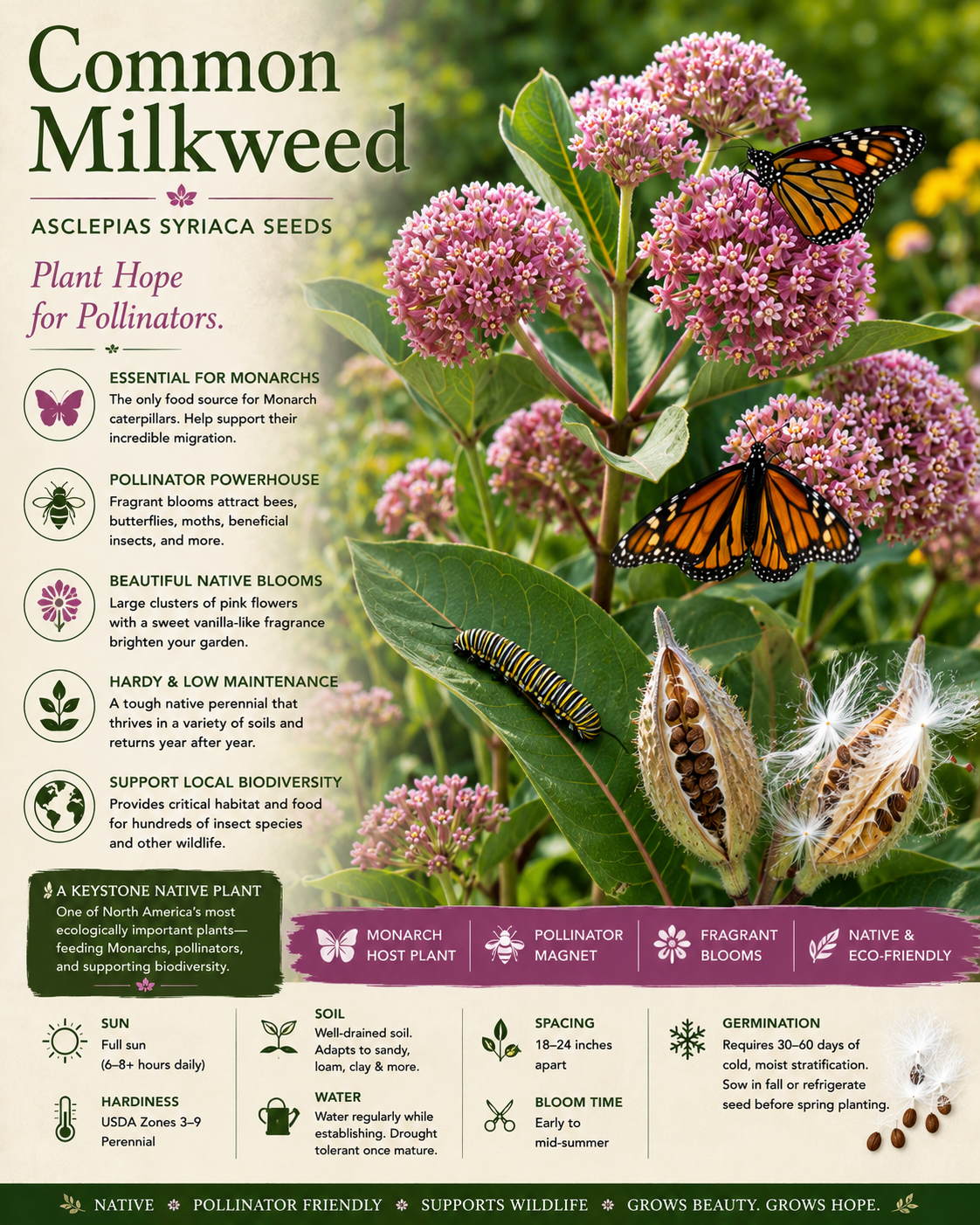

Description
Common Milkweed Seeds
Plant Hope for Pollinators.
Some flowers are beautiful.
Common Milkweed helps sustain an entire ecosystem.
Native to much of North America, Common Milkweed is far more than a wildflower. Its fragrant pink flower clusters feed countless bees, butterflies, and beneficial insects, while its leaves provide the only food that Monarch butterfly caterpillars can eat. By planting Common Milkweed, you’re creating essential habitat for one of nature’s most remarkable migrations.
Beautiful, resilient, and incredibly valuable to wildlife, Common Milkweed is one of the most meaningful native plants you can grow.
Why Grow Common Milkweed?
🦋 Essential for Monarch butterflies.
Common Milkweed is one of the primary host plants for Monarch butterflies. Female Monarchs lay their eggs on its leaves, and the emerging caterpillars rely on milkweed as their exclusive food source.
🐝 A pollinator powerhouse.
Its fragrant, nectar-rich blooms attract honey bees, native bees, butterflies, hummingbird moths, beneficial wasps, and dozens of other pollinating insects throughout the summer.
🌸 Beautiful native blooms.
Large clusters of fragrant pink flowers create a stunning display while filling the garden with a sweet vanilla-like fragrance.
🌱 A hardy native perennial.
Once established, Common Milkweed is remarkably drought tolerant, long-lived, and returns larger each year with very little maintenance.
🌎 Support local biodiversity.
Growing native plants like Common Milkweed helps restore habitat, strengthen local ecosystems, and provide critical food sources for wildlife.
A Keystone Native Plant
Common Milkweed is considered one of North America’s most ecologically important native plants. Researchers have documented hundreds of insect species that depend on milkweed for nectar, pollen, shelter, or reproduction. While Monarch butterflies are its most famous visitors, many native bees, beetles, flies, moths, and other beneficial insects also rely on milkweed throughout their life cycles.
Planting Common Milkweed is one of the simplest and most impactful ways home gardeners can support declining pollinator populations.
Growing Information
Sun: Full sun (6–8+ hours daily).
Soil: Well-drained soil. Adaptable to sandy, loamy, clay, and average garden soils.
Planting Depth: Sow seeds ¼ inch deep.
Spacing: 18–24 inches apart.
Water: Water regularly while establishing. Mature plants become highly drought tolerant.
Bloom Time: Early to mid-summer.
Hardiness: USDA Zones 3–9. A hardy native perennial.
Germination Tip
Common Milkweed benefits from 30–60 days of cold, moist stratification before spring planting. Many gardeners simply sow seeds outdoors in late fall, allowing winter to naturally break dormancy. Freshly stratified seed generally germinates more reliably and uniformly.
Perfect For
- Pollinator gardens
- Monarch waystations
- Native plant landscapes
- Prairie gardens
- Meadow plantings
- Wildlife habitats
- Rain gardens
- Naturalized areas
Common Milkweed pairs beautifully with Purple Coneflower, Black-eyed Susan, Bee Balm, Joe-Pye Weed, Blazing Star, New England Aster, and native grasses.
Did You Know?
- Monarch caterpillars cannot survive without milkweed. It is their exclusive host plant.
- The flowers produce abundant nectar, making them favorites of bees, butterflies, and hummingbird moths.
- Its silky seed floss helps carry seeds long distances on the wind each autumn.
- Milkweed naturally spreads over time through underground rhizomes, forming beautiful colonies that provide even more habitat for wildlife.
More Than Just a Wildflower
Every packet of Common Milkweed seeds grows more than flowers.
It grows food for Monarch caterpillars.
Nectar for countless pollinators.
Habitat that strengthens local ecosystems.
And the opportunity to make a real difference—one garden at a time.
Plant Common Milkweed, and help the next generation of Monarch butterflies take flight.